
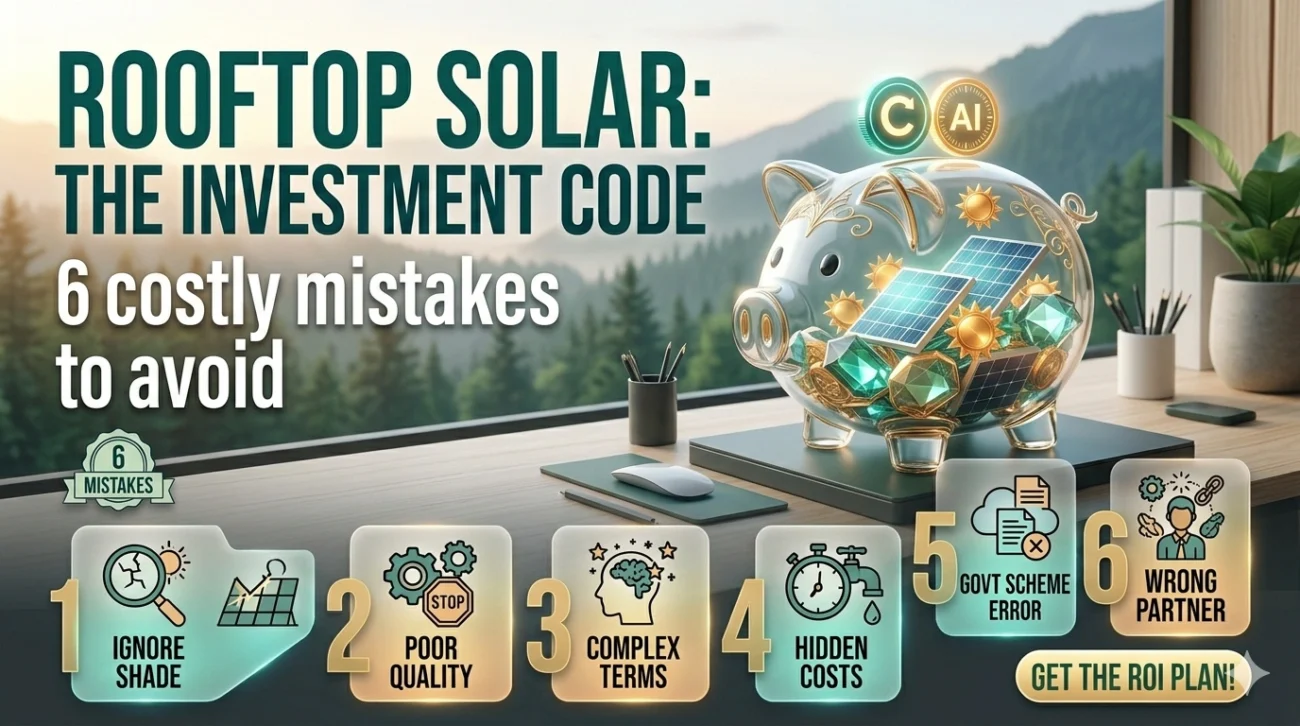
Rooftop solar investment in India 2026 is one of the smartest ways to save money and build long-term wealth. With rising electricity costs, government subsidies, and improved solar technology, more Indian households are shifting to solar energy to reduce bills and earn stable returns.
Why Rooftop Solar Investment in India 2026 Is Booming
Rooftop solar investment in India is no longer just an eco-friendly choice — it has become one of the most profitable long-term investments for Indian households and businesses. With rising electricity tariffs, government subsidies, and improved solar technology, homeowners are now able to cut electricity bills by up to 80–90%.
In 2026, solar adoption is accelerating due to:
- Rising power costs across Indian states
- Government push for renewable energy
- Net metering policies
- Falling solar panel installation costs
For investors and homeowners alike, rooftop solar offers a rare combination of low risk, stable returns, and long-term savings.
How Rooftop Solar Works: Simple Explanation for Beginners
A rooftop solar system converts sunlight into electricity using solar panels installed on your roof. The electricity generated is used to power your home, and excess energy can be sent back to the grid through net metering.
Key Components:
- Solar Panels
- Inverter
- Mounting Structure
- Net Meter
Once installed, the system generates free electricity for 20–25 years, making it a powerful passive investment.
Rooftop Solar Investment in India 2026: Cost vs Savings Breakdown
Here’s a realistic cost and return comparison for Indian households:
| System Size | Approx Cost (₹) | Govt Subsidy (₹) | Net Cost (₹) | Monthly Savings | Payback Period |
|---|---|---|---|---|---|
| 1 kW | ₹60,000–₹75,000 | ₹18,000–₹30,000 | ₹40,000–₹50,000 | ₹800–₹1,200 | 4–5 years |
| 3 kW | ₹1.8–2.2 lakh | ₹54,000–₹78,000 | ₹1.2–1.5 lakh | ₹2,500–₹4,000 | 4–6 years |
| 5 kW | ₹3–3.5 lakh | ₹78,000–₹1 lakh | ₹2–2.5 lakh | ₹5,000–₹8,000 | 4–6 years |
👉 After the payback period, your electricity is practically free for the next 15–20 years, making rooftop solar one of the highest ROI investments in India.
Government Subsidy on Rooftop Solar in India 2026
The Indian government offers subsidies under the National Solar Rooftop Portal to promote renewable energy adoption.
Key Benefits:
- Up to 40% subsidy for small residential systems
- Direct benefit transfer to bank account
- Reduced installation cost
- Faster ROI
This makes solar installation more accessible and affordable for middle-class households.
6 Rooftop Solar Investment in India 2026 Mistakes to Avoid
1. Choosing the Wrong System Size
Many people either overspend on larger systems or install undersized systems that don’t meet their needs.
👉 Solution:
Analyze your monthly electricity consumption before installation.
2. Ignoring Panel Quality and Warranty
Cheap panels may save money upfront but result in lower efficiency and higher maintenance costs.
👉 Solution:
Choose Tier-1 solar panels with 25-year performance warranty.
3. Not Understanding Net Metering Policies
Different states in India have different net metering rules, which directly impact savings.
👉 Solution:
Check your state’s DISCOM policy before investing.
4. Falling for Unrealistic ROI Claims
Some vendors promise extremely high returns, which are not realistic.
👉 Solution:
Expect a 4–6 year payback, not 2–3 years.
5. Poor Installation and Vendor Selection
Low-quality installation reduces system efficiency and lifespan.
👉 Solution:
Always choose experienced, certified solar installers.
6. Ignoring Maintenance and Cleaning
Dust and dirt reduce solar efficiency significantly in India.
👉 Solution:
Clean panels every 15–20 days for optimal performance.
Is Rooftop Solar Investment in India 2026 Worth It?
Yes — rooftop solar is one of the best low-risk investments in India today because:
- Guaranteed savings on electricity bills
- No market risk like stocks
- Long lifespan (20–25 years)
- Government-backed incentives
- Increasing electricity inflation
Compared to traditional investments like FDs (6–7%), rooftop solar can generate 15–20% effective returns annually.
Rooftop Solar Investment in India vs Traditional Investments: Which Is Better?
| Investment Type | Returns | Risk Level | Liquidity | Stability |
|---|---|---|---|---|
| Fixed Deposit | 6–7% | Low | High | Stable |
| Mutual Funds | 10–15% | Medium | Medium | Market Dependent |
| Stocks | 12–18% | High | High | Volatile |
| Rooftop Solar | 15–20% | Low | Low | Very Stable |
👉 Rooftop solar stands out as a stable, inflation-proof investment.
How to Maximize Rooftop Solar Investment in India 2026 Returns
To get the best ROI from your solar investment:
- Install system based on actual consumption
- Use high-efficiency panels
- Take full advantage of subsidies
- Maintain and clean regularly
- Monitor performance using apps
- Avoid shading on panels
Step-by-Step Process to Install Rooftop Solar in India
- Calculate electricity usage
- Select system size
- Apply on national solar portal
- Choose certified vendor
- Install system
- Get net meter approval
- Start saving on electricity bills
Long-Term Benefits of Rooftop Solar Investment in India
- Zero electricity bills after payback
- Protection from rising tariffs
- Increase in property value
- Sustainable and eco-friendly
- Energy independence
Conclusion: Why 2026 Is the Best Time for Rooftop Solar Investment in India
Rooftop solar investment in India 2026 is not just about saving electricity—it’s about building financial freedom. By avoiding costly mistakes and following smart strategies, you can maximize returns, reduce dependency on rising tariffs, and enjoy decades of free energy.
If you’re still waiting to invest in rooftop solar, you’re actually losing money every month through electricity bills. With subsidies, improved technology, and rising electricity costs, 2026 is the perfect time to switch.
Rooftop solar is not just an expense — it’s a long-term wealth-building asset that delivers consistent returns for decades.
FAQs on Rooftop Solar Investment in India
Q1. What is the cost of installing rooftop solar in India in 2026?
The cost ranges from ₹60,000 per kW, depending on system size and quality. Subsidies can reduce costs significantly.
Q2. How long does it take to recover solar investment?
Typically 4–6 years, after which electricity is almost free.
Q3. Is rooftop solar better than investing in mutual funds?
Solar offers stable returns (15–20%) without market risk, while mutual funds depend on market performance.
Q4. Do solar panels work during power cuts?
Grid-connected systems shut off during outages unless you have battery backup.
Q5. How long do solar panels last?
Most panels last 20–25 years with minimal maintenance.
About The Author
