
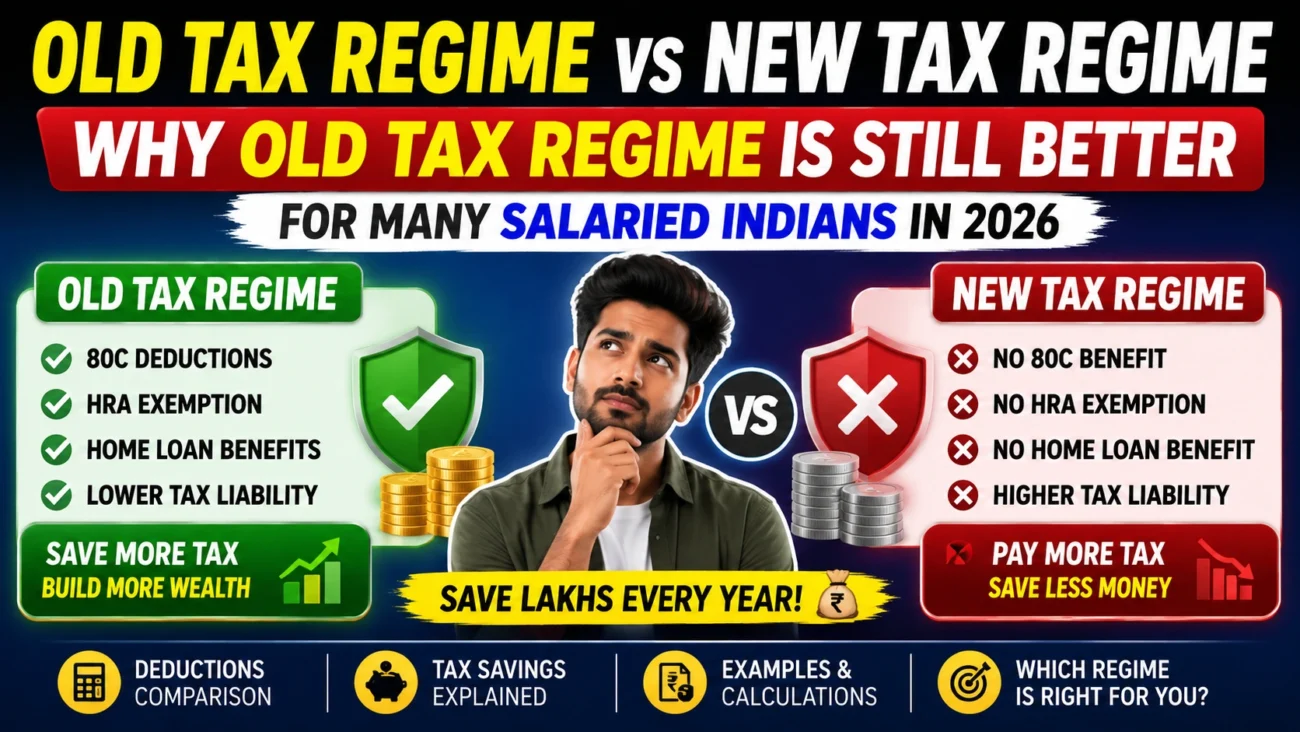
Old Tax Regime vs New Tax Regime is one of the biggest financial questions salaried Indians face in 2026. While the new tax regime offers lower tax slabs and simplified calculations, many taxpayers still save significantly more money under the old tax regime through deductions like Section 80C, HRA, home loan benefits, and health insurance exemptions.
Introduction: Old Tax Regime vs New Tax Regime Confusion is Growing Every Year
Ever since the Indian government introduced the new tax regime, salaried employees have been confused about one major question:
Which tax regime actually saves more money — old or new?
At first glance, the new tax regime looks attractive because of its lower tax slabs and simplified structure. But when people actually calculate their taxes carefully, many realize something surprising:
The old tax regime is still better for a large number of Indians.
Especially if you are:
- A salaried employee
- Paying home loan EMIs
- Investing under Section 80C
- Paying health insurance premiums
- Receiving HRA benefits
- Supporting a family
Then the old tax regime may still help you save significantly more tax.
In this detailed guide, we will break down:
- Difference between old and new tax regime
- Latest tax rules explained simply
- Why the old regime still works better for many Indians
- Salary examples and tax comparisons
- Who should choose which regime
- Common mistakes people make while selecting tax regime
Let’s simplify everything step by step.
Old Tax Regime vs New Tax Regime: What Has Changed in 2026
The Indian income tax system currently offers two options:
Old Tax Regime
The old tax regime allows taxpayers to claim:
- Deductions
- Exemptions
- Tax-saving investments
This means you can reduce taxable income using:
- Section 80C
- HRA
- Home loan benefits
- 80D health insurance
- NPS deductions
- LTA
- Standard deduction
New Tax Regime
The new tax regime offers:
- Lower tax rates
- Simpler tax calculation
- Fewer deductions and exemptions
The government introduced it mainly to simplify taxation and reduce paperwork.
But simplicity does not always mean lower tax liability.
Why the Old Tax Regime is Still Better for Salaried Employees
The biggest reason is simple:
Most salaried Indians already invest and spend in ways that qualify for deductions.
For example:
- EPF contributions
- Home loan principal repayment
- Tuition fees
- LIC premiums
- ELSS investments
- Health insurance
These are common financial activities in Indian households.
Under the old regime, all these help reduce taxable income significantly.
Under the new regime, most of these benefits disappear.
That is why people with disciplined financial planning often save more tax under the old regime.
How Section 80C Makes the Old Tax Regime Powerful
One of the biggest advantages of the old regime is Section 80C deduction.
You can claim up to ₹1.5 lakh deduction through:
- EPF
- PPF
- ELSS mutual funds
- Life insurance premium
- Tax-saving FD
- Home loan principal
- Sukanya Samriddhi Yojana
- Children’s tuition fees
For middle-class salaried Indians, this alone creates huge tax savings.
Example:
If your taxable income is ₹12 lakh and you invest ₹1.5 lakh under 80C, your taxable income reduces to ₹10.5 lakh.
This directly lowers your tax burden.
Why HRA Exemption Still Makes a Big Difference
Many salaried employees living in metro cities pay high rent.
Under the old regime, you can claim House Rent Allowance (HRA) exemption.
This becomes extremely valuable in cities like:
- Mumbai
- Bengaluru
- Delhi
- Hyderabad
- Pune
- Gurgaon
For someone paying ₹25,000–₹40,000 monthly rent, HRA exemption can save a substantial amount every year.
The new tax regime removes this advantage completely.
How Home Loan Benefits Make the Old Regime Better
India has millions of homeowners paying EMIs.
Under the old regime, you get:
- Deduction on home loan principal under 80C
- Deduction on interest up to ₹2 lakh under Section 24(b)
This is a massive tax-saving benefit.
For many families, these deductions alone make the old regime clearly superior.
Especially in cities where property prices and EMIs are high.
Why Families Benefit More Under the Old Tax Regime
The old regime rewards financially responsible behavior.
If you:
- Buy insurance
- Save for retirement
- Invest regularly
- Pay education expenses
- Support dependents
Then you naturally qualify for multiple deductions.
Indian middle-class families often follow exactly this pattern.
That is why the old regime still aligns better with real-life financial planning for many households.
Which Deductions Are Available in the Old Tax Regime?
Here are some major deductions still available:
| Deduction | Benefit |
|---|---|
| Section 80C | Up to ₹1.5 lakh |
| Section 80D | Health insurance |
| HRA | Rent exemption |
| Standard Deduction | Salaried employees |
| Home Loan Interest | Up to ₹2 lakh |
| NPS (80CCD) | Extra ₹50,000 |
| LTA | Travel benefits |
| Education Loan Interest | Section 80E |
These deductions together can reduce taxable income dramatically.
Why the New Tax Regime Looks Attractive Initially
The new regime markets itself as:
- Simpler
- Faster
- Lower tax rates
- Less documentation
And for some people, it genuinely works better.
Especially:
- Young earners with no investments
- People without home loans
- Freelancers with minimal deductions
- Individuals preferring simple taxation
But many salaried employees only look at lower slab rates without calculating lost deductions.
That’s where confusion begins.
When the New Tax Regime Can Actually Be Better
The new regime may work better if:
- You do not invest under 80C
- You do not pay rent
- You have no home loan
- You prefer higher monthly in-hand salary
- You are just starting your career
Example:
A fresher earning ₹6–₹8 lakh annually with minimal deductions may benefit more from the new regime.
But as income grows and financial responsibilities increase, the old regime often becomes more beneficial.
Old Tax Regime vs New Tax Regime Salary Comparison
Let’s compare a salaried employee earning ₹15 lakh annually.
Under Old Tax Regime
Deductions:
- 80C = ₹1.5 lakh
- Home loan interest = ₹2 lakh
- Standard deduction = ₹50,000
- Health insurance = ₹25,000
Total deductions = ₹4.25 lakh
Taxable income becomes:
₹15 lakh – ₹4.25 lakh = ₹10.75 lakh
This significantly reduces tax liability.
Under New Tax Regime
Most deductions disappear.
Taxable income remains close to full salary.
Even with lower slab rates, total tax payable can often become higher.
This is why proper calculation matters.
Biggest Mistakes People Make While Choosing Tax Regime
Choosing Based Only on Lower Tax Slabs
Many people ignore deductions completely.
Not Calculating Total Tax Liability
Always compare final payable tax under both regimes.
Ignoring Long-Term Wealth Creation
The old regime encourages:
- Investing
- Insurance
- Retirement planning
The new regime sometimes discourages disciplined financial habits.
Listening to Social Media Without Personal Calculation
Tax planning is personal.
What works for one person may not work for another.
Does the Old Tax Regime Help Build Wealth?
Yes — indirectly.
The old regime pushes people toward:
- Investing
- Saving
- Retirement planning
- Insurance protection
This creates better long-term financial discipline.
For example:
- ELSS creates equity exposure
- PPF builds safe retirement savings
- NPS builds pension corpus
- EPF grows automatically
These habits create wealth over decades.
Which Tax Regime is Better Old Tax Regime vs New Tax Regime for Salaried Employees in India?
For many salaried employees, the old regime still wins if they have:
- Home loan
- HRA
- Insurance
- 80C investments
- NPS contribution
- Family responsibilities
Especially in metro cities where expenses are high.
The more deductions you claim, the more attractive the old regime becomes.
Should You Switch Between Old Tax Regime vs New Tax Regime Every Year
Salaried employees usually get flexibility to choose annually.
That means:
- You should calculate taxes under both regimes every financial year
- Your choice should depend on:
- Salary
- Investments
- Deductions
- Life stage
There is no universal answer.
How to Decide Between Old Tax Regime vs New Tax Regime
Ask yourself these questions:
Do you invest under 80C?
If yes, old regime becomes attractive.
Do you pay rent?
HRA benefits favor old regime.
Do you have a home loan?
Old regime often saves much more.
Do you buy insurance?
80D deductions matter.
Do you want simple taxation?
New regime may suit you better.
The final decision should always come after proper tax calculation.
Conclusion: Old Tax Regime vs New Tax Regime
The new tax regime may look modern and simple, but for millions of salaried Indians, the old regime still delivers better tax savings.
Especially if you:
- Invest consistently
- Pay EMIs
- Support a family
- Plan finances seriously
- Use deductions smartly
The old regime rewards financial discipline and long-term planning.
Before selecting any regime blindly, calculate both options carefully.
Because sometimes, what looks “simpler” is not actually “cheaper.”
And in personal finance, saving more money always matters.
FAQs on Old Tax Regime vs New Tax Regime
Which tax regime is better for salaried employees in India?
For salaried employees with deductions like HRA, home loan, 80C investments, and insurance, the old tax regime is often better.
Is the old tax regime still available in 2026?
Yes, taxpayers can still choose between old and new tax regimes depending on eligibility and tax planning.
Can I switch between old and new tax regime every year?
Most salaried individuals can choose between regimes every financial year while filing returns.
Why do people still prefer the old tax regime?
Because deductions under 80C, HRA, home loan interest, and insurance can reduce taxable income significantly.
Is the new tax regime better for beginners?
It may benefit young earners with fewer deductions and simpler finances.
Does the old tax regime help save more money?
For many middle-class families with investments and loans, yes — it often results in lower total tax liability.
About The Author
