
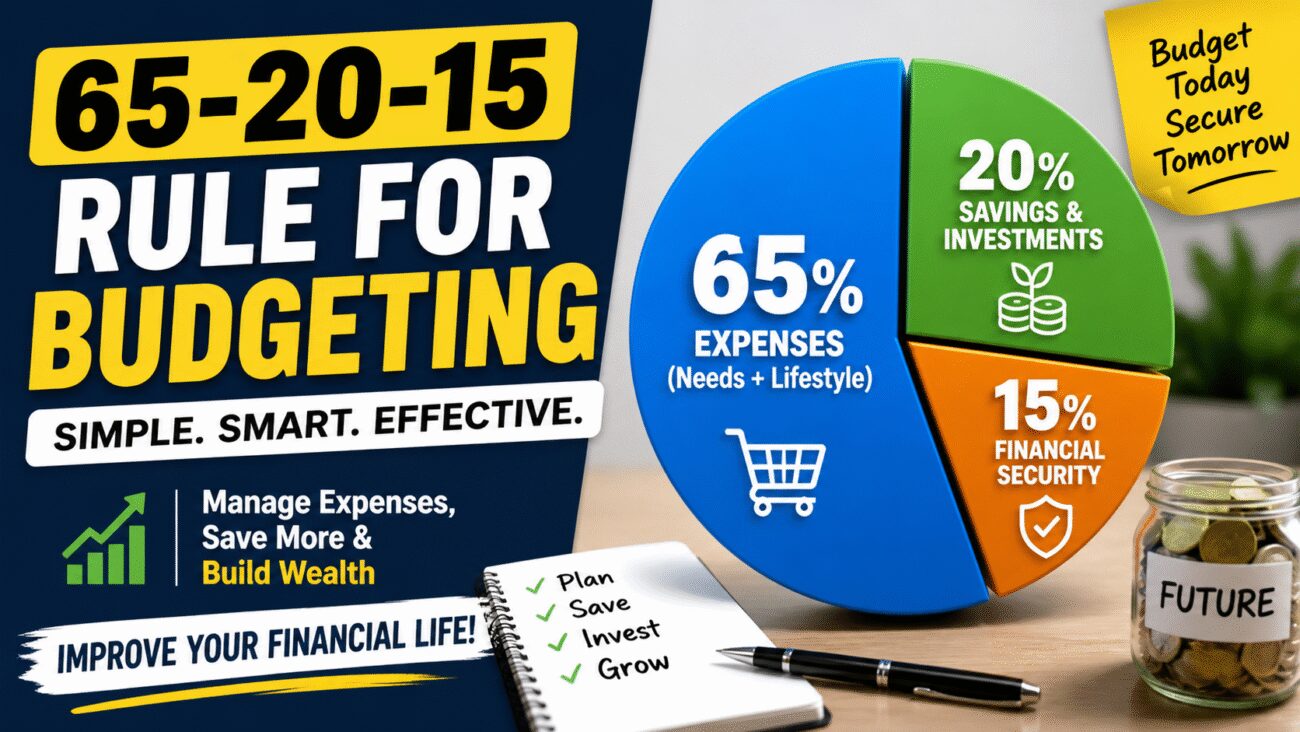
The 65-20-15 rule for budgeting is one of the simplest and most powerful ways to manage your money effectively in today’s fast-changing financial world.
Why Do Most People Fail at Managing Their Monthly Budget?
Managing money sounds simple, but in reality, most people struggle every single month. Salary comes in, expenses go out, and before you know it, there’s barely anything left to save or invest.
The problem is not always income — it’s lack of structure in money management. Without a clear budgeting system, people overspend on lifestyle, ignore savings, and delay investments. Over time, this leads to stress, dependency on credit, and financial instability.
This is where a simple, practical budgeting rule can completely change your financial life.
The 65-20-15 rule is one such modern approach that simplifies how you handle your money — without making your life restrictive.
What is the 65-20-15 Rule of Budgeting?
The 65-20-15 rule is a simple money management formula that divides your income into three clear parts:
- 65% for Expenses (Needs + Lifestyle)
- 20% for Savings & Investments
- 15% for Financial Security (Insurance + Emergency + Future Protection)
This rule is designed to balance present lifestyle, future wealth, and risk protection — all at the same time.
Unlike traditional budgeting rules, this approach recognizes that modern life includes EMIs, lifestyle spending, and rising costs — while still ensuring you build wealth consistently.
How is the 65-20-15 Rule of Budgeting Different from the 50-30-20 Rule?
Many people are familiar with the 50-30-20 rule, but the 65-20-15 rule is more practical for today’s financial reality.
Here’s the key difference:
- The 50-30-20 rule separates needs and wants strictly, which is often hard to follow.
- The 65-20-15 rule combines spending into one category, making it simpler and more flexible.
In real life, people don’t always clearly separate needs and wants. Rent, EMIs, subscriptions, eating out — everything mixes together.
That’s why the 65-20-15 rule works better — it focuses on simplicity and consistency, not perfection.
How to Apply the 65-20-15 Rule Step-by-Step?
Step 1: Calculate Your Monthly Income
Start with your total monthly income:
- Salary (after tax)
- Freelance or side income
- Business earnings
Let’s assume your monthly income is ₹50,000.
Step 2: Allocate 65% for Expenses
65% of ₹50,000 = ₹32,500
This includes:
- Rent or home loan EMI
- Groceries and utilities
- Transportation
- Mobile bills, subscriptions
- Eating out and lifestyle
The goal is simple: keep your total spending within 65%.
If your expenses exceed this, it’s a warning sign that you’re heading toward financial stress.
Step 3: Allocate 20% for Savings and Investments
20% of ₹50,000 = ₹10,000
This is where your future wealth is built.
You can allocate this into:
- SIPs in mutual funds
- Stocks (if experienced)
- PPF or long-term savings
- Retirement funds
Consistency matters more than amount. Even small monthly investments grow significantly over time due to compounding.
Step 4: Allocate 15% for Financial Security
15% of ₹50,000 = ₹7,500
This portion is often ignored — but it’s critical.
Use this for:
- Health insurance
- Term insurance
- Emergency fund
- Contingency savings
This ensures that unexpected situations (medical emergencies, job loss) don’t destroy your financial plan.
Why the 65-20-15 Rule Works So Well in 2025
The financial world has changed. Rising inflation, easy credit, and lifestyle upgrades make traditional budgeting harder to follow.
The 65-20-15 rule works because it is realistic.
- It allows flexibility in spending
- It enforces disciplined saving
- It protects against risks
- It is easy to remember and apply
Most importantly, it aligns with how people actually live today — not an idealized version of money management.
What Are the Biggest Benefits of the 65-20-15 Budget Rule?
1. Simplicity
You don’t need complex spreadsheets or categories. Just follow three clear buckets.
2. Better Financial Balance
You’re not just saving — you’re also protecting and enjoying your money.
3. Reduced Financial Stress
Knowing that your finances are structured reduces anxiety around money.
4. Consistent Wealth Creation
With 20% dedicated to investments, your wealth grows automatically over time.
5. Protection Against Emergencies
The 15% allocation ensures you are financially prepared for unexpected events.
Common Mistakes to Avoid While Following This Rule
Even a simple rule can fail if not applied correctly. Avoid these mistakes:
- Spending more than 65% of income
- Ignoring the 15% security portion
- Investing irregularly instead of consistently
- Using savings for unnecessary expenses
- Not adjusting budget when income changes
Discipline is the key to making this rule work.
How to Adjust the 65-20-15 Rule Based on Your Income Level?
Not everyone earns the same — so flexibility is important.
For Lower Income Individuals
- Expenses may go up to 70–75%
- Reduce investments temporarily but don’t stop them
For Higher Income Individuals
- Reduce expenses to 50–55%
- Increase investments to 25–30%
The rule is a guideline, not a rigid formula. Adapt it to your situation.
How to Use the 65-20-15 Rule to Become Financially Independent?
Financial independence is not about earning crores — it’s about managing money correctly.
By following this rule consistently:
- You build a strong investment corpus
- You avoid unnecessary debt
- You stay prepared for emergencies
- You reduce dependence on salary
Over time, your investments start generating income — and that’s when true financial freedom begins.
Practical Example of the 65-20-15 Rule in Real Life
Let’s take a simple example:
Monthly Income = ₹80,000
- Expenses (65%) = ₹52,000
- Investments (20%) = ₹16,000
- Security (15%) = ₹12,000
If you invest ₹16,000 monthly with a 12% return, in 20 years you could build a corpus of over ₹1.5 crore.
That’s the power of consistent budgeting + compounding.
How to Stay Consistent with This Budgeting Rule?
Consistency is where most people fail. Here’s how to stay on track:
- Automate SIP investments
- Track expenses weekly
- Use budgeting apps
- Review finances monthly
- Increase investments with salary hikes
The simpler your system, the easier it is to stick with it.
Conclusion: A Simple Rule That Can Change Your Financial Future
The 65-20-15 rule is not just another budgeting technique — it’s a practical framework for modern money management.
It helps you:
- Live your present comfortably
- Secure your future
- Build long-term wealth
You don’t need complicated strategies to become financially strong. What you need is clarity, discipline, and consistency.
Start today, even with a small income. Because the sooner you follow a structured plan, the faster you move towards financial independence.
FAQs on the 65-20-15 Budget Rule
Q1. What is the 65-20-15 rule in budgeting?
It is a budgeting method where 65% of income is used for expenses, 20% for savings and investments, and 15% for financial security like insurance and emergency funds.
Q2. Is the 65-20-15 rule better than the 50-30-20 rule?
It can be more practical because it simplifies spending into one category and focuses more on real-life financial behavior.
Q3. Can beginners follow the 65-20-15 rule easily?
Yes, it is one of the easiest budgeting methods because it only requires dividing income into three parts.
Q4. What if my expenses are more than 65% of my income?
You should gradually reduce unnecessary expenses or increase income to align with the rule over time.
Q5. How does this rule help in financial independence?
By consistently saving and investing 20% of your income, you build long-term wealth that can eventually replace your active income.
About The Author
