
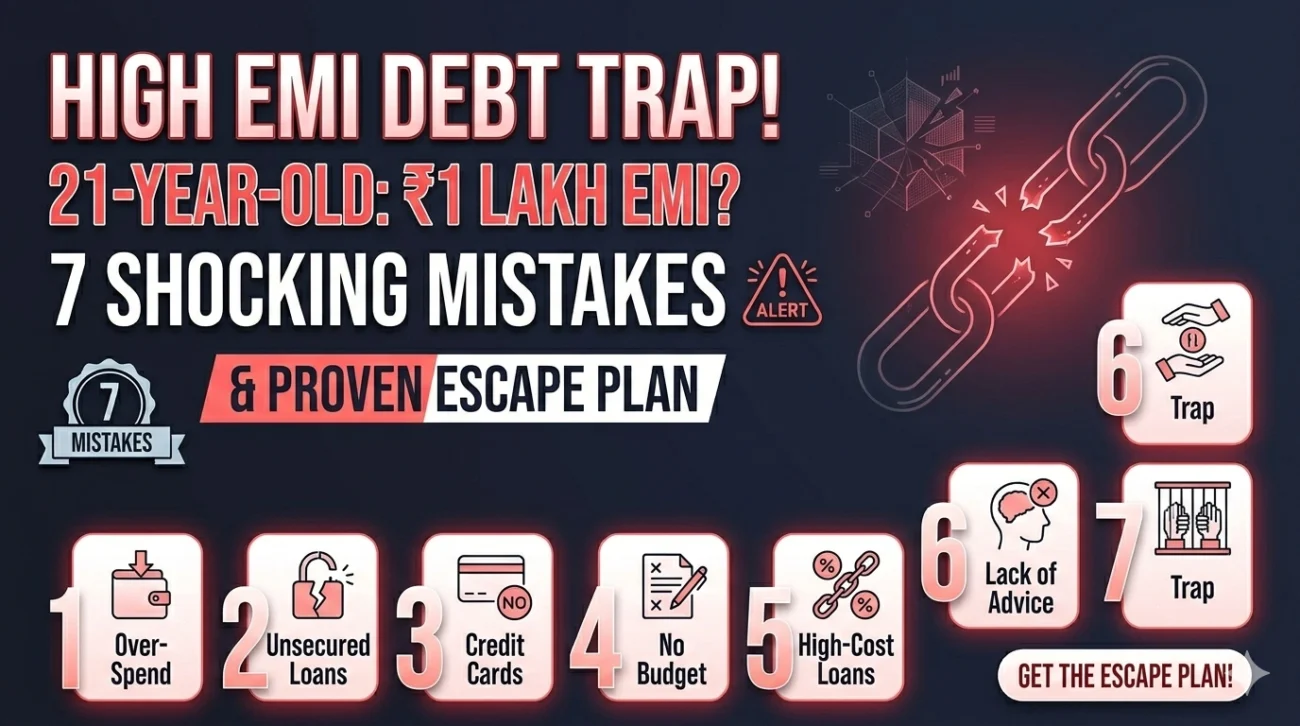
High EMI debt trap in India is becoming a serious financial problem among young earners. With instant loans, BNPL apps, and easy credit access, even 21-year-olds are ending up with ₹1 lakh monthly EMI. This guide explains why it happens and how to escape fast.
Why High EMI Debt Trap in India is Rising in 2025
In today’s digital India, getting a loan is easier than ordering food online. With instant approvals, Buy Now Pay Later (BNPL) apps, credit cards, and personal loans, many young earners are stepping into debt without fully understanding the consequences.
A shocking reality is emerging — even 21-year-olds are stuck paying ₹1 lakh monthly EMI, leaving them financially stressed at the very beginning of their careers.
This isn’t just about poor decisions — it’s a mix of financial illiteracy, lifestyle pressure, and easy credit access.
Causes of High EMI Debt Trap in India Among Young Indians
Let’s break down how someone so young ends up in such a situation:
- Multiple credit cards with high limits
- Personal loans for lifestyle expenses
- BNPL purchases stacking up
- Car or gadget loans taken early
- Lack of budgeting or financial planning
These combined create a snowball effect, where EMIs pile up faster than income growth.
How High EMI Debt Trap in India Affects Your Financial Life
| Financial Factor | Impact of High EMI Burden |
|---|---|
| Savings | Almost zero |
| Investment Ability | Completely restricted |
| Mental Stress | Extremely high |
| Credit Score (CIBIL) | High risk of damage |
| Career Flexibility | Limited (job dependency) |
| Financial Freedom | Delayed by years |
👉 This table clearly shows that high EMIs don’t just affect your wallet — they affect your entire life trajectory.
Warning Signs of High EMI Debt Trap in India
Before things get out of control, watch for these red flags:
- Paying only minimum due on credit cards
- Taking loans to repay existing EMIs
- More than 40–50% of income going to EMIs
- No emergency savings
- Constant financial stress
If you relate to even 2–3 of these, you’re already in the danger zone.
Step-by-Step Plan to Escape High EMI Debt Trap in India
Step 1: Calculate Your Total Debt Clearly
List down:
- All loans
- Interest rates
- EMIs
- Outstanding amount
Clarity is the first step toward control.
Step 2: Stop Taking New Loans Immediately
No new credit cards. No BNPL. No “easy EMI” offers.
This is where most people fail — they keep adding fuel to the fire.
Step 3: Prioritize High-Interest Loans First
Use the Debt Avalanche Method:
| Loan Type | Priority Level | Reason |
|---|---|---|
| Credit Cards | Highest | 30–40% interest |
| Personal Loans | High | 12–18% interest |
| Consumer Loans | Medium | Moderate rates |
| Home Loan | Low | Lowest interest |
Focus aggressively on clearing high-interest debt first.
Step 4: Reduce EMI Burden Using Smart Strategies
- Convert credit card dues into lower-interest personal loans
- Negotiate with banks for lower interest rates
- Extend tenure temporarily (for breathing space)
- Use balance transfer if cheaper options are available
Step 5: Increase Your Income Streams
Cutting expenses alone won’t solve everything. You need to increase income:
- Freelancing (design, coding, writing)
- Online tutoring or consulting
- Selling unused assets
- Learning high-income skills
Step 6: Cut Lifestyle Expenses Aggressively
For the next 6–12 months:
- No luxury spending
- No unnecessary subscriptions
- Minimal dining out
- No impulse shopping
This phase is temporary but crucial.
Step 7: Build a Basic Emergency Fund
Even while repaying debt, keep at least ₹20,000–₹50,000 buffer to avoid falling back into loans.
Smart EMI Comparison: Avoid Debt Trap in India
| Type of EMI | Example | Good or Bad | Reason |
|---|---|---|---|
| Home Loan EMI | Buying a house | Good | Asset creation |
| Education Loan EMI | Skill development | Good | Future income growth |
| Car Loan EMI | Luxury car early | Bad | Depreciating asset |
| Credit Card EMI | Shopping, gadgets | Worst | High interest + no asset |
👉 Not all EMIs are bad — but most lifestyle EMIs destroy wealth.
How to Avoid High EMI Debt Trap in India in Your 20s
- Follow 50-30-20 rule strictly
- Never use more than 30% of credit card limit
- Build emergency fund early
- Start SIP instead of EMI lifestyle
- Delay big purchases until financially stable
The Shift That Changes Everything: From EMI Mindset to Investment Mindset
Most people spend their 20s paying EMIs. Smart people spend their 20s building assets.
Instead of paying ₹20,000 EMI on gadgets, imagine investing ₹20,000 monthly:
| Monthly Investment | Years | Approx Value (12% return) |
|---|---|---|
| ₹20,000 | 10 | ₹46 lakhs |
| ₹20,000 | 20 | ₹2 crore+ |
👉 This is the difference between financial struggle and financial freedom.
Long-Term Strategy: Become Debt-Free and Build Wealth
Once you escape the EMI trap:
- Start SIPs in mutual funds
- Invest in index funds or blue-chip stocks
- Build retirement corpus (PPF, NPS)
- Take term & health insurance
- Create multiple income streams
Conclusion: Don’t Let Early Mistakes Destroy Your Financial Future
Being stuck in ₹1 lakh EMI at 21 is not just a financial problem — it’s a life problem. But the good news is, it’s reversible.
With discipline, planning, and smart decisions, you can:
- Escape debt
- Rebuild your finances
- Create wealth early
Remember:
Your 20s should be about building assets, not paying liabilities.
FAQs
Q1. How much EMI is safe for salary in India?
Ideally, EMIs should not exceed 30–40% of your monthly income to avoid financial stress.
Q2. What is the fastest way to reduce EMI burden?
Focus on high-interest debt first, use balance transfer, and increase income to accelerate repayment.
Q3. Can I negotiate my loan EMI with banks?
Yes, banks may offer restructuring, lower interest rates, or extended tenure based on your repayment history.
Q4. Is taking EMI for gadgets a bad decision?
Yes, gadget EMIs are usually bad because they are depreciating assets with no long-term value.
Q5. How can young people avoid debt traps in India?
By budgeting, avoiding unnecessary loans, building emergency funds, and focusing on investments instead of EMIs.
About The Author
